San Diego: Leadership Symposium #RTMk12

On December 7th, I flew to San Diego for my first #RTMk12 Leadership Symposium. I was not sure what to expect, but I figured I would give it a fair shot since I really enjoy learning. I am so glad I attended because it was a complete, thoughtful, and inspirational conference. There were educational leaders from school districts all across the country, from Tech and Instruction district leaders to Superintendents.

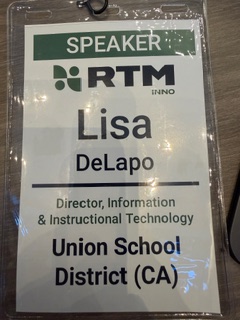
nametag RTM

I was so happy to see my previous mentee, Kyleigh Nevis, from CITE CTO Mentor Program (Cohort 19) at this Symposium, and I found other rockstar-level educators that I had not seen in ages, like Bill Bass, Lisha Brunache, Roger Goss, Brad Krey, and Edward Hilton, just to name a few. This conference was so different than anything I have ever attended, and what RMT does makes it extra special.

Day 1: We started right before Noon on Sunday with a kick-off and opening keynote by Dr. Amber Teamann, Executive Director of Technology & Innovation. She tlked about leadership in times of chaos, and gave us all some great advice around leading with purpose. Later, I was able to meet with SAM Labs and Quill.org as a 1:1, 30-minute, get-to-know the product demo. I decided ahead of time which vendors I was most interested in, and they were all complete unknown entities to me at the beginning. I really enjoyed the ability to meet with the vendors and ask questions, and much of the time went by so quickly, they should have kicked me out of their booths! I was happy that I could come back to talk to them during the night time socials or at our meals, where they joined in on our conversations since many were former educators.

My last workshop of the day was with Aaron Rogers (not the football guy – apparently they spell their last names differently). Aaron is an Apple Distinguished Educator who works as a Director of Digital Content in a school district in Texas. His fast-paced session was full of excellent ideas on the early adoption of AI and technology in the classroom. I definitely made a new friend in Aaron, and I cannot wait to see how much more he changes the world of education. I led my Roundtable session on this day, and I was very surprised at how many of us are in the same boat when it comes to AI planning. My biggest advice to my colleagues was this: We don’t have a policy for pencils, and any misuse of a pencil is covered under other policy (i.e., weapons/harm). Just add it to your responsible use policy and create an instructional guidebook for professional development for students and teachers, as well as decide on ethical use and create ethical statements with students. Finally, dinner and drinks were great; they fed you snacks and full meals while you’re here. Wow.

Nichole Smith from Classlink says hello

Day 2: Breakfast was super early, but oh so yummy. We attended the keynote by Antonio Vigil, Director of Innovative Classroom Technology in Aurora, Colorado. He took us from the Renaissance period to the future in his keynote, asking us difficult questions and presenting different solutions. Next, I attended a session by Magic School AI. I know many of our teachers use the free version but students cannot use it. Next, I met Second Step (Committee for Children), and they intrigued me with their future-ready skills intertwined with social-emotional lessons. I totally got on board with this, and I need to see which schools are using this curriculum already. I then had to run to do my Virtual Roundtable, which I led a discussion on the same AI and Tech planning. Unfortunately, the hotel internet was not great, so I got dropped a couple of times. Thank goodness RTM was on the Zoom too and kept things flowing. And then, it was lunch!

Look who I found! Lisha Brunache

After lunch, we did not get to nap, but we had a great group discussion with 2nd Step. I really liked Polly, Jessica, and Sheridan’s presentation; they are a thoughtful group of women who really believe in future-ready skills. My next vendor meetings were with TrueMark and Defined. Both are amazing vendors, and I am looking into using TrueMark for our middle schools. Thomas at TrueMark became my instant bestie during the conference – what an amazing human being! Defined also captured my attention — which led me to miss part of the Leadership Talk by Aaron Baughman at MI Virtual Academy. Back to Defined – I really want to use this product as well. Everything centers around CTE and future-ready skills, a theme that is all about my own framework in teaching and learning. I felt like I had met “my people” and I did not want our time to end. We then had a nice free-tme break and dinner was served at 6;30pm with a reception that followed. By 9:30pm, I was exhausted.

Day 3: We started with an early workshop before breakfast. The workshop was done by Michelle Bourgeois, CTO of St. Vrain Valley in Colorado. She did a fun, engaging, easy-to-understand cybersecurity presentation, and we all agreed with Michelle that none of it matters without building relationships with the people first. After breakfast, most of us used the break to get checked out of our hotel rooms.

Kristin shows us the HRS Framework

We returned to the Closing Workshop, led by Kristin Reidy, Asst. Superintendent of Marana USD in Arizona. Her energy alone was so stimulating and engaging – and this was where I learned about Robert Marzano’s High Reliability Schools framework. (I ended up buying two more of his books off Amazon during this session.) I loved how Kristin showed us how her district excelled and brought up attendance, achievement, and all-things-education. At the end of this session, RTM gave away an iPad Mini, an Apple Watch, and a Donor’s Choose gift certificate. I won the Watch — 2nd place in the online activity. Thank you, RTM!

Kyleigh Nevis – My CITE CTO Mentee and friend

It was very sad leaving; it was like a wonderful summer camp, and you had to say goodbye to your old and newfound friends. RTM puts on a great conference, and this one felt more intimate than big conferences like CUE or CITE (and I love those two conferences a lot, and to be fair, it’s like comparing apples to watermelons). The one thing they (CUE/CALIE, CITE, and RTMk12) all have in common is the people you meet. We all connect in some way, and we all strive for meaningful and innovative education of our students. It always comes back to the people.

Education & AI

I read something today on LinkedIn that made me think a lot more about how education needs to let go of the past and embrace reality – and perhaps, maybe even get future-thinking!? I would settle for at least embracing the present. AI has been exponentially improving in the weeks and months since it became the “next big thing.” Like Mr. Bauschard says in his LinkedIn post, “AI will keep getting better/more extensive, but education keeps on acting like AI is the enemy.”

As so many people who are using AI have already pointed out that calculators freaked out math teachers long ago. Google and other search engines freaked out English and social studies teachers. Google Translate freaked out world language teachers… but yet, nothing changed the way students were taught in the classroom. We preached as ed-tech coaches that students Googling answers meant that teachers were asking students the wrong questions, and yet we see the same types of questions being asked.

Look, I get it. We are smart teachers that have degrees – many with advanced degrees, more often than not. We were taught with our desks in rows, no technology or social media, everyone was mostly compliant, and we had a lot of old textbooks and mimeographed worksheets. (Ahh, smell that purple ink!) We grew up, and “we turned out fine.” Maybe… But this isn’t about us any more – if teaching was ever about us. Our students are the ones that will be entering the workforce in 2030 and beyond, not with the skills from the 1980s or 1990s that we’re teaching them. Our students will become the last picked for the global game of life because we are still neglecting to use the tools of today and tomorrow, to update how, what, where, and when we teach.

The World Economic Forum stated that the top ten skills on the rise were:

  1. Creative thinking
  2. Analytical thinking
  3. Technological literacy
  4. Curiosity & life-long learning
  5. Resilience, flexibility, & agility
  6. Systems thinking
  7. AI & big data
  8. Motivation & self-awareness
  9. Talent management
  10. Service orientation & customer service

(Source: World Economic Forum, Future of Jobs Report, 2023.)

So seeing this list, I have to wonder and ask of anyone reading this: Can AI spill these things onto a screen for a student? This is not a copy & paste & turn it in type of exercise… and school (and the future of work) should not be either.

I am going to repeat… I am neither an AI-pioneer nor self-proclaimed AI in education expert. I do not want to be. I just want school to be meaningful, engaging, based in reality and maybe based in a little sci-fi/future. Like Mr. Bauschard stated in that LinkedIn post, education cannot keep running away from AI with the belief that it this static thing that isn’t always learning to improve. I guess AI has us beat in that aspect too – are we always willing to learn to improve?

These opinions are mine and do not represent my employer or its employees. It may, however, reflect some past ones.

Education is broken

I have been thinking about writing this blog post for months, and I finally have the time and energy to do it. I keep ranting to whoever will listen that teaching must change to meet the needs of the future. We are no longer teaching students to become doctors, lawyers, or other traditional professional occupations — if we ever were? I think the way we have been teaching, since the 1900s, is dominated by teacher as content deliverer and students as consumption-regurgitation receptacles. And maybe at one point, this was necessary, but today’s world has changed so much. We have devices in every classroom, we have high-speed internet, we have artificial intelligence… but we’re still teaching like any of the content isn’t available freely on Google or ChatGPT. We have forgotten how to teach our future adults how to think critically, work collaboratively, create new and interesting ideas, and communicate to an entire world that is waiting to hear their voices, outside of the small classroom audience.

Why are some of us teaching like we’re still in the 1900s? I keep asking myself this question, day in and day out. Yes, there are teachers who do try to incorporate future-ready thinking and learning, but many easily burn out when they receive peer pressure and feedback from colleagues or site and district administrators, despite all students thriving and succeeding in achieving more than just what is required on a fill-in-the-bubble test. Is it easier to teach like it is the 1900s? Yes, probably, but we cannot do what’s easy. Some teachers will blame the students, saying they are disrespectful, hate school, and are addicted to being online. Yes, students are different – they have technology at their fingertips and have for most of their lives – but we’re not letting them learn how they like to learn. We’re not even giving them choices, and we’re definitely not acknowledging what worked for us in school (in the 80s, 90s) cannot be utilized as a teaching method for today. It is a different world – one that changes every day – but education does not…

The good news: I watched a teacher in my own district who knows each of her students’ strengths and areas of growth, what they each enjoy, and what motivates each of them. She has built a community of learners that highly respect each other and themselves. She does her own version of a “smart-start” every year and when students return from longer breaks (i.e., winter break), and this basically is relationship-building at its finest. She builds trust, camaraderie, gratitude, and value for each student and their unique abilities. You can walk into her classroom at any given time, and you will see students working collaboratively and creatively. They read the books they enjoy, personalizing their own learning and feeding on their intrinsic motivation to be amazing citizens of the world.

You cannot personalize or individualize learning without knowing the learner. Sure, 80% might be successful in any given middle-class, socio-economically developed neighborhood school, no matter the teaching style or content, but when is that good enough? If you are neglecting the other 20% because they have special education needs, or because they learn differently, or because their single parent is working two to three jobs and can’t be home to help them with homework or help them with developing language and literacy skills…

Today’s world is Volatile, Uncertain, Complex, and Ambiguous (VUCA, created by Bennis & Nanus in 1985). We are experiencing such rapid change with technology and media right now, and education does not take into consideration the agility and adaptability that we need to be able to pivot on a dime. I thought that maybe the pandemic would have changed this in education when it required all educators to be able to be online – but that did not actually give us the change we needed – that was simply substituting Zoom for the same old classroom setting and teaching. Online teaching does require a different style of teaching than in-person, but it does not change the fact that you still must know and interact with your learners and create a safe, trusting environment for them to take risks and show their learning abilities.

So, how should we be teaching? Well, we can start with this list:

  • Do NOT be the content delivery machine.
    • Ask kids to tell you what they already know about a topic.
    • Ask kids to tell you what they are curious about with that topic.
    • Let the kids search the web for answers to the wonders and questions.
  • Once they have the content, do NOT ask them to regurgitate it into an essay or worksheet or quiz.
    • Instead, have them apply that knowledge along with your guidance to something else they are passionate about.
    • Ask them to show their learning in unique ways – maybe it’s creating a comic book story about the topic or building a model with modern enhancements. The world is their oyster – give them opportunities to think outside the box.
  • Do NOT limit them to one app or one type of media (i.e., paper). Let them choose how they deliver their learning.
    • Not everyone likes written tests, essays, worksheets, flashcards.
    • Not everyone wants to do everything on their Chromebook.
    • Not everyone likes to do crafts.
    • The ability to choose their own medium is part of their learning.
  • Have students build a portfolio, website, or drive folder with all of their ideas and project products.
    • Perhaps make folders that are standards-based and allow them to choose their best work to put into that folder.
    • Include reflection every time. If students do not evaluate their own learning, they will continue to make the same half-attempts at doing things to please the teacher versus for their own learning journey.
  • Allow collaboration. It’s a skill we need for the future.
    • How many teachers like to work in grade-level meetings to develop lessons together? Sometimes we are better together. Let kids decide!
  • Remember that compliance does not equal learning.
    • Kids sitting in rows, quietly doing worksheets on their own, and wearing the correct attire for school/dress code does not improve learning – nor engagement.
    • Some kids thrive when they stand, when they can walk around…. every student is different, As long as it is safe, let them learn.
  • The person doing all of the work is doing most of the learning.
    • I have seen teachers creating the most beautiful, time-consuming slide decks on Canva. That’s great – but if the student did that, they’d probably gain skills in presenting, speaking, collaborating, creativity…

I could keep going. In fact, that’s what this whole “becausekids” is about… but there is only so much time and energy for this post today. I will share more soon. It’s holiday break, and I have a little more time. I may surprise myself with another post soon. Until then, stay safe, be well, and relax. Your mental health and brain deserve the break.

Unpacking the Acer 714 Spin

As soon as I received the device from CDW-G, I was eager to get started. It took me a few minutes to find the stylus – under the keyboard. I popped it out, and immediately went to Cursive (cursive.apps.chrome) to try it out. I think I type faster than I write, but sometimes, I love just jotting notes down for referencing later. I see how this could be useful when at a meeting – when the clicking of keys can be distracting, for example.

I next went to docs.new and started typing. I love the keyboard on the Acer 714 Spin – the keys are soft and effortless to press, and it took no time at all to get used to. The 14″ wide screen is beautifully clear, but it will take a while for me to get used to having a touchscreen display. When I use my Surface laptop, I always forget it has a touchscreen – and I rarely use that feature.

The Acer 714 Spin comes with one HDMI port, a headphone jack, a USB-A slot, and two USB-C slots. I think the HDMI port is going to help when I am in a classroom setting, if the TV isn’t outfitted with a Chromecast. Most of our schools have TVs with both: Apple TV and Chromecast for teachers and students to share screens. I typically teach in the Makerspace classrooms (since I choose to teach two classes at a time), and I will have to see if our TVs and projectors in those rooms are programmed to work together on the Chromecast side.

The Acer 714 Spin allows me to use my home’s Wi-Fi 6E, which is supposedly faster to connect to. I will have to check if the district APs have 6E enabled. Weighing in at 3.06 pounds, the Acer 714 Spin is about the same weight as my 13″ MacBook Pro. It also has the same amount of storage as my MacBook Pro (256gb). Since I try to save everything to Google Drive, I am not sure what I will do with that extra storage.